Cats have an innate ability to make us feel better when we aren’t feeling quite ourselves. While we know that therapy dogs have long since been the norm for comforting humans in need, recent research proves that cats can do the same. Now, this isn’t to say that all cats possess this trait—similarly in the way that not all dogs are suitable for therapy work. However, the study found that sociable cats can work their purrfect powers on humans to alleviate stress and calm anxiety. Keep reading to discover how effective cats can be as therapy pets.
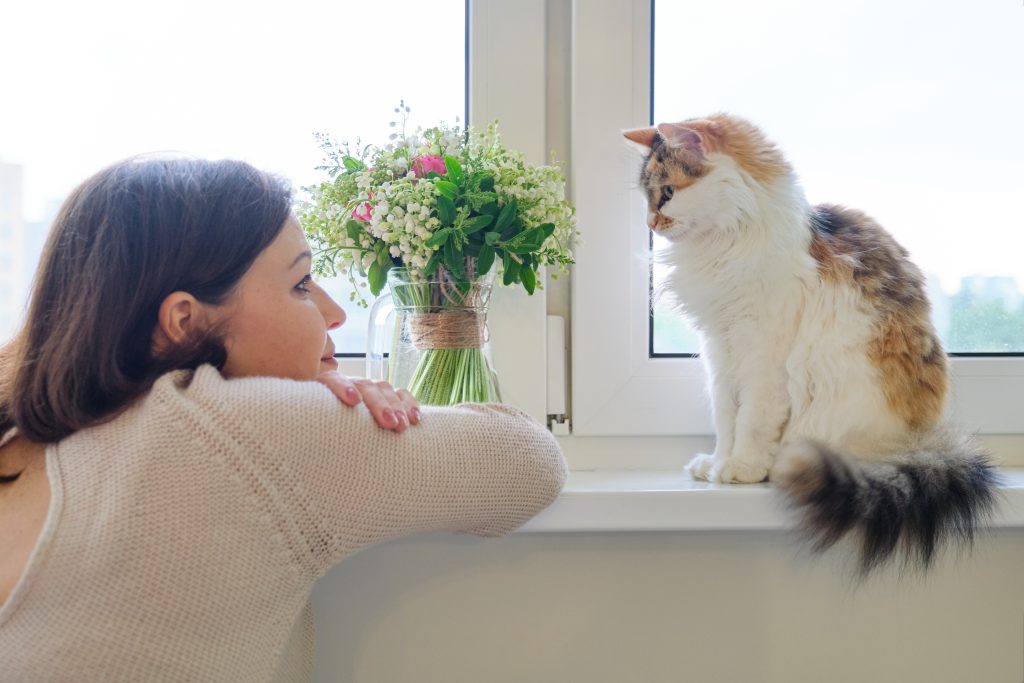
First off, what is a therapy cat?
As I mentioned above, our minds naturally might think “dog” when it comes to a therapy pet. But many sociable cats are quickly breaking the mold and proving to the world the power of the purr—among other things. Similar to canines, the purpose of a therapy cat is to provide comfort and emotional support to individuals in need. Cats suitable for therapy work are outgoing, calm, and social. Cats that are skittish or easily agitated are not ideal candidates when it comes to animal-assisted services (AAS). Unlike dogs, the main difference between cats and dogs in therapy settings is that cats are typically not trained to do therapy work.
The study: Behavioural Profile Differences Between Cats in Animal-Assisted Services (AAS) and Non-AAS Cats Using the Fe-BARQ in Flanders
To conduct their study and test their theory that cats can and should be used in AAS therapy programs, hundreds of cat owners in Belgium were given a “standardized behavioral assessment.” The abstract of the study starts with the following important information:
The engagement of cats in animal-assisted services (AAS) is increasing. This is surprising given that feline behavioural needs have been perceived as contradictory to conditions associated with AAS engagement, leading to the assumption that cats as a species are not suitable for AAS. However, important within-species variability in behavioural traits nuancing this assumption has not been addressed.
To conduct their study, the standardized behavioral assessment was conducted in 2021, using the popular only research study platform, Qualtrics. The official study findings stated that researchers: conducted the survey in which cat behaviour profile data were collected from cat caregivers. Invitations to participate were distributed online through convenience sampling targeting cat caregivers through various channels. The recruitment flyer described a call for “participation in an online study about cat personality, with a special interest in cats engaged in AAS or cats who accompany their caregivers outside their residence” and included a picture of a cat.
Patricia Pendry, a professor at Washington State University, collaborated with Belgian researchers to prove her theory that people in therapy can benefit from the presence of felines.
Pendry said, “There’s this perception that cats just aren’t suitable for this kind of work, but our study shows that some cats may thrive in these settings. It turns out that cats who engage in AAS exhibit the same behavioral traits as therapy dogs — like high sociability and a willingness to engage with people.”

The proof is in the results.
Dogs are wonderful, but the enthusiastic energy of a dog is not an ideal fit for everyone. Some attending therapy might gravitate to the calm and quiet of a cat to help them feel at ease. Pendry also noted that while larger, naturally more docile cat breeds, such as Maine Coons, may be viewed as more sociable by nature, the study intended to gather research from cats overall and not individual differences among breeds of cats. When you think about it, it makes perfect sense because the average cat person has a shelter cat, which is usually a mixed cat breed. Allowing for more inclusive research yielded better results to prove how a cat can excel at therapy with humans.
Kiro 7 News shared, “Despite the study’s findings, researchers stress that more work is needed before therapy cats become a mainstream option. Questions remain about whether these traits are innate or developed through experience and how to ensure that therapy work does not negatively impact feline welfare.” Additionally, it was noted that the study’s goal wasn’t specifically targeted to promote cats in therapy work but to recognize that some cats may genuinely enjoy and benefit from this interaction in the proper setting. Pendry concluded cats in therapy can provide “meaningful support to people who need it.”
If you ask me, it sounds like a win-win for cats and humans!

Want to learn more about cats as therapy animals? Check out this article here on CattitudeDaily.com.
For detailed information on this study, check out this link here: https://www.mdpi.com/2076-2615/15/1/33